



If you’re searching “can GPTZero Humanize text”, chances are you’ve used AI to draft something and now it feels a little too polished, too predictable, or too robotic. Perhaps, you also fear that it might be reported by an AI detector. Now, of course, you are asking yourself whether GPTZero can be used to make that better.
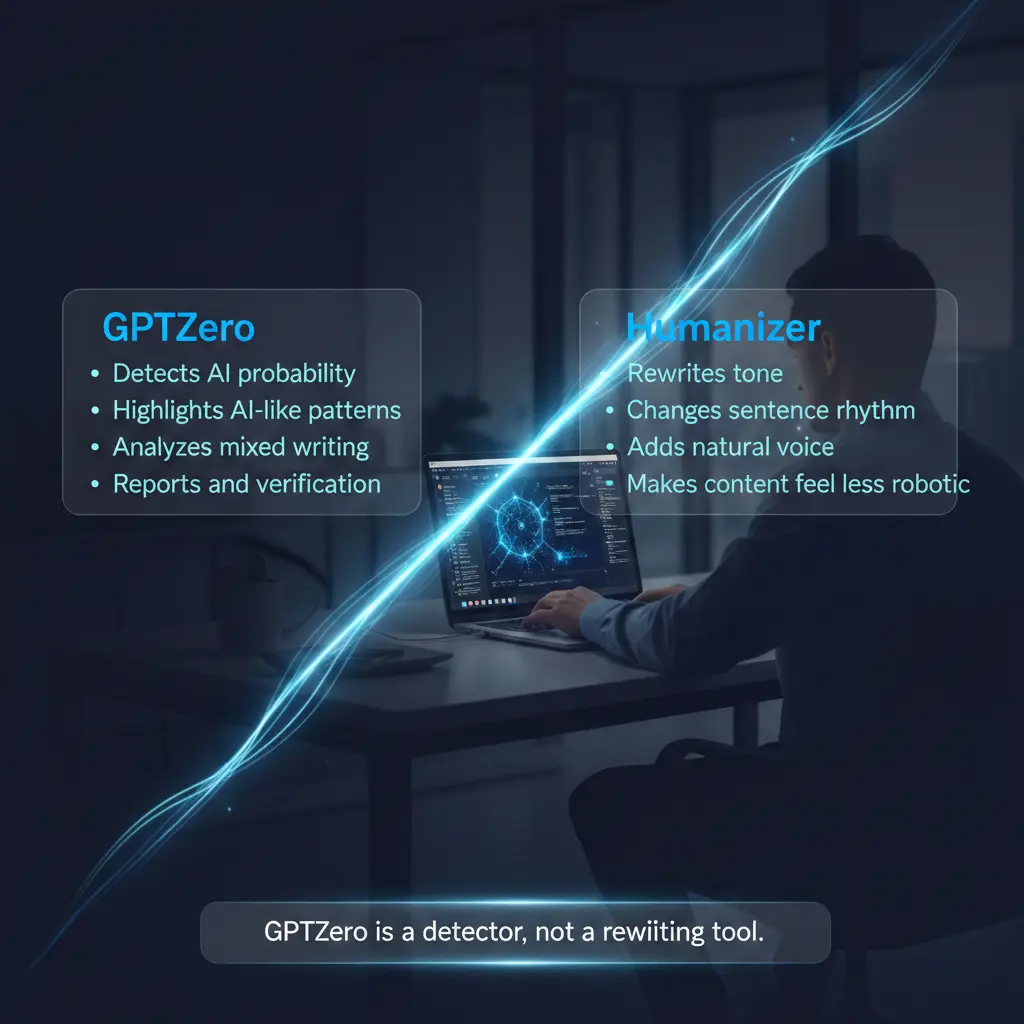
This is the obvious answer: GPTZero is not aimed at humanizing text. It is mainly used to determine whether a piece of content was created by an AI.
That said, the full picture is more nuanced. It does not mean that GPTZero cannot be used to enhance your writing, provided that you need a higher level of credibility, originality, and professionalism. Here, we are going to discuss what GPTZero does, what it means to humanize, where detectors fail, and the manner in which businesses ought to apply AI-assisted writing in 2026 in a responsible manner.
GPTZero markets itself as an AI detector. It analyzes written information and approximates the likelihood that the text comes out of a large language model like:
Its core function is analysis, not creation. GPTZero is not designed to create content.
Instead, it operates as a humanize detector, meaning it analyzes patterns to determine whether writing resembles machine-generated output.
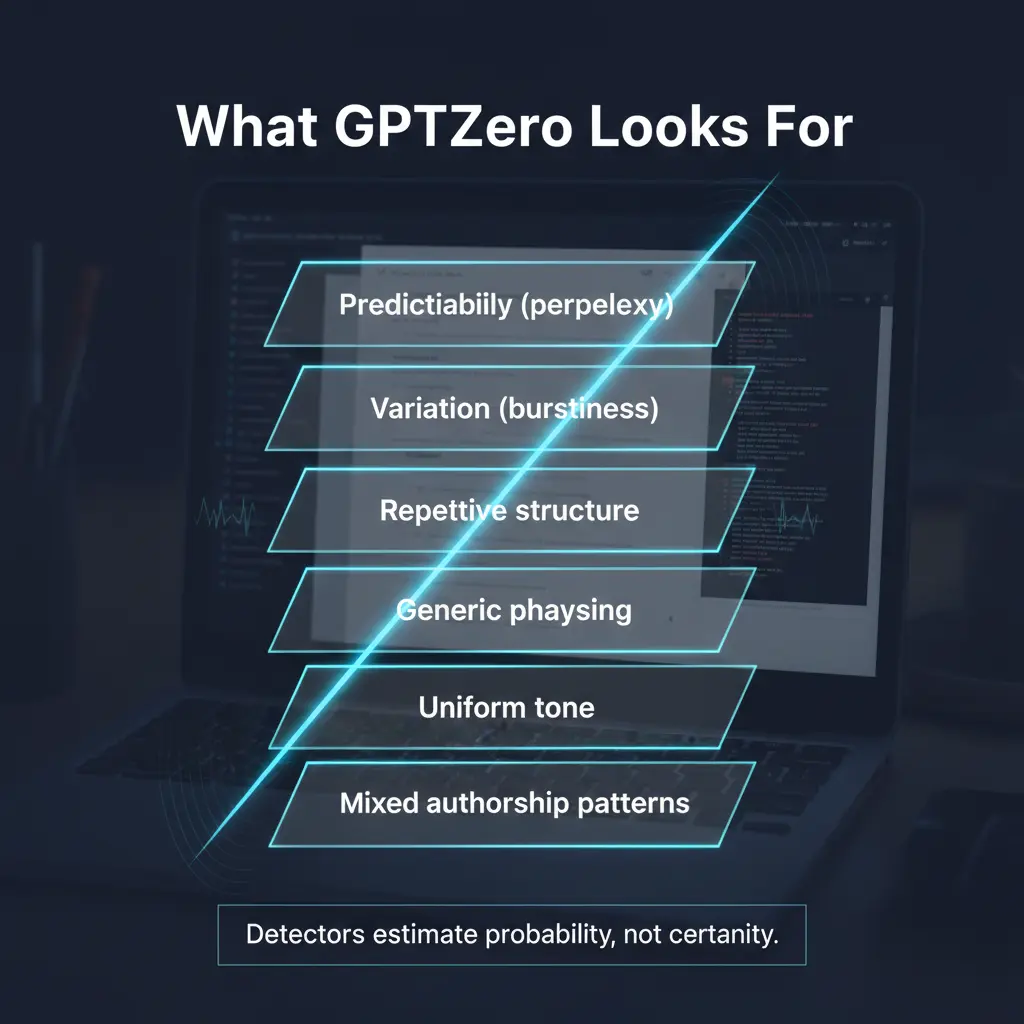
The first concepts that GPTZero attracted attention to were:
Perplexity: An indication of the predictability of the language.
Burstiness: An index of the variation of that predictability between sentences.
With time, the system was developed into a more layered system of detection. It now takes into account other linguistic and structural indicators. The underlying goal is however the same.
It is constructed to recognize writing patterns that seem to be structured, uniform or statistically consistent to that of text produced by machine.
GPTZero has now gone well beyond a paste-and-scan checker. It is now a wider detection and writing analysis platform targeting educational institutions, business and content reviewers. The following is what it practically provides.
The main aspect is its AI detection system.
In addition to the detection feature, GPTZero has a number of writing-based features. These are grammar checker, writing feedback recommendations, citation and fact checking, plagiarism scanning and authorship verification reports. Although these tools allow making the text more clear and correct, it does not automatically transform the text into a more human voice.
GPTZero is connected to Chrome, Google Docs, and learning management systems, like Canvas and Moodle. It also provides API and Zapier integrations to automate workflows, which is handy to the institutions and organizations.
GPTZero claims to be an incredibly precise business AI detector, citing internal evaluation and external benchmarks, such as data sets, such as RAID. Nonetheless, the actual accuracy of detection may be different, especially in the case of highly edited content.
We should also define what people mean by humanizing AI text before deciding whether GPTZero is helpful or not. The words are easy to say and in a sense of it are very different intentions.

In 2026, such a term typically is divided into three categories.
This is the most responsible case of usage. You use AI to come up with a rough draft. Then you revise it carefully. You restructure thoughts, reinforce points, provide real-life examples, bring in personal remarks and prove facts. The AI is not the ultimate creator, but its beginning.
In this case, AI will act as brainstorming. The revised version is a result of your professionalism, opinion, and perception. That is not deception. It is collaboration.
In some cases, humanizing will merely entail the refinement of the writing style.
This can be the elimination of:
This form of editing is prevalent in marketing, blogs and in work communication. It is not to hide but to be clear and genuine.
The third meaning is even more problematic. Here, someone attempts to rewrite AI-generated content specifically to bypass a humanize detector. This can manifest itself in the form of academic misconduct, ghostwriting, or subpar production of SEO content.
This is not what GPTZero was created and it is also highly unethical.
No. GPTZero is not able to humanize text.
None of the in-app functionalities of GPTZero rephrases your work to sound more natural or more human. There is no “GPTZero humanize text” button. It does not paraphrase, change the tone and add a personality to your writing.
It also does not transform text generated by AI into content that cannot be detected. GPTZero is not designed to hide AI generated text or even present machine drafts as completely human. It does not create other forms of your text that are humanized.
“Ready to dominate your niche? RDA, your trusted UGC Content Creator, crafts content that builds buzz, earns trust, and drives real growth. Start with us today!”
Although GPTZero is not a rewritable tool, it can still promote improved editing in a couple of indirect ways.
Think of it like this:
GPTZero is the X-ray.
You still have to do the surgery.
Here’s how it can help.
AI writing tends to rely on the safe and predictable language.
For example:
Such expressions are not necessarily bad. However, as your writing is too dependent on them, it begins to be generic and machine-like in sound.
GPTZero showscase such trends in order to identify where your writing is too smooth or where it lacks originality. That can out of the way to rewrite passages with transitions that are more natural and words.
In case your writing has awkward language, grammar errors, or unnatural structure, the writing tools at GPTZero can be used to polish your work. This enhances readability and makes your writing flow easier. Nevertheless, it still fails to produce a new one using your own voice. It merely raises issues to be improved.
Numerous actual papers are confused. Some sections are human. Some are AI. Some are heavily edited. GPTZero can even show the sections that appear too AI, and it makes you more focused in making edits on the areas where they are needed. Nevertheless, the rewriting is again required to be performed manually.
Authorship reports are also available in GPTZero. This does not concern the humanization of text. It is concerning the promotion of evidence of authorship of the content. To businesses, this may be important in the processes of hiring, publication of standards and compliance or internal writing policies.
This is where the majority of the people fail to understand. It is not an ideal science of AI detection. The best detectors are limited even significantly.
In case one reformats AI text extensively, detectors have a hard time. One study associated with the University of Chicago was a test of several detectors, such as GPTZero, against:
GPTZero performed decently overall. But it had a hard time with humanized AI content and it missed approximately half of such cases in that case.
That means:
In case it has been over-edited, GPTZero will not necessarily be able to identify AI.
This is the biggest risk. Human writing is sometimes recognized as AI.
This can happen when:
So when GPTZero is used as a final judge, they will be able to hurt honest writers.
AI detectors work more effectively on long contents.
Short content like:
That is why the “humanize detector” category is messy.
People often search for AI humanize test free because they want a free way to check:
“Does this sound human?”
GPTZero can be used like that. But only in a limited way.
It does not measure:
It is primarily an evaluation of probability patterns.
So yes, you can use GPTZero as a basic AI humanize test free tool. It will not make your content human though. And it ought to be no evidence of anything.
In case you want to make the writing with the help of AI sound more natural, there are less risky, smarter ways of doing it.
Here’s what works in 2026.
AI is excellent in general writing. Human beings are detail oriented.
For example:
The less general your writing is, the more personal it becomes.
AI writing tends to have the same rhythm. Same sentence length. Same flow. Same structure. Human writing is more varied.
Add:
AI loves filler. Humans cut it.
Remove:
“In conclusion”
“Additionally”
“It’s worth noting.”
Replace with:
AI plays safe. Humans take a stance.
For example:
This enhances the reality of content.
The goal is not to “beat GPTZero.” The goal is to write content that people trust. That is what builds a brand.
In the case of business content, the greatest threat is not the detection. The greatest threat is credibility.
If your content feels:
Your buyers will feel it. Even without it being noticed by a detector.
This matters for:
The truth is simple. Individuals will be able to feel AI content in 2026. Even without tools.
GPTZero is most applicable when it is considered as a single signal.
Here are good use cases:
Writers double-check that their writing is not being misreadIn each of them, there is a process that is supported by GPTZero.
So it is obvious the answer to the primary question: GPTZero cannot humanize text itself. It is designed to identify AI patterns of writing, and not to conceal them, recreate them, or humanize them. Its strength is analysis, which would assist in determining material that is generic or machine-like.
To achieve a better writing in 2026, you should simply do what is right, and that is all. AI can be used to brainstorm or draft, and then a human editor is allowed to make amends. Include personal examples, explicit views and tangible evidence to ensure that the completed work is representative of you.
Want Content That Sounds Human and Still Performs in Google?
Royal Digital Agency helps businesses to produce blog content that ranks, develops trust, and that which is written by an expert. To have assistance in writing SEO material with natural voice, clear format with a powerful EEAT signal, contact and ask to review your content strategy.
No. GPTZero is a humanizer not an AI detector. It does not paraphrase your work to make it more human. It just gets the text and guesses the probability that it was created by an AI.
Not directly. GPTZero has the capability of pointing out sections akin to AI and providing feedback, but you have to rewrite it by hand. Any of the humanizing is as a result of your edits, rather than GPTZero.
GPTZero may be helpful, yet it is not flawless. It can overlook human writing that has been greatly edited by AI, and occasionally misunderstand human writing. It should not be a decision-maker as it is a support tool.
GPTZero offers free scanning, so you can use it as a basic AI humanize test free tool. Nonetheless, it measures AI probability patterns only. It is not gauging voice realness or brand tone.
Royal Digital Agency focuses on human-first content strategy. It implies well-organized text, informal language, good EEAT indicators, and the text that is authentic to consumers. Nonetheless, the final voice should sound as a real expert, which AI can help.





Let’s talk about how to take your product’s digital experience to the next level.


