


Did you know that more than 74% of businesses worldwide already use or plan to use artificial intelligence? That number is rising in 2026.
Think about it. From Netflix recommending your next show to chatbots answering your questions right away, AI is quietly shaping your daily life. Yet most people still ask a simple question: how does AI work?
The truth is, AI is not even a tech trend anymore. It is becoming the backbone of modern business, marketing and digital experiences.
In this guide, you will learn what AI is, how it works step by step, real examples of AI, and how businesses use it to grow. Everything is explained in a simple, clear way.
Connect for AI Solutions
Artificial Intelligence (AI) is a branch of computer science that lets machines and software learn from data, recognize patterns, and perform tasks that usually need human intelligence. These tasks include making decisions, solving problems, understanding language and seeing images. The systems keep getting better through experience and feedback.
You already use AI every day, even if you don’t notice it:
These are all examples of AI solving real problems with data and smart algorithms.
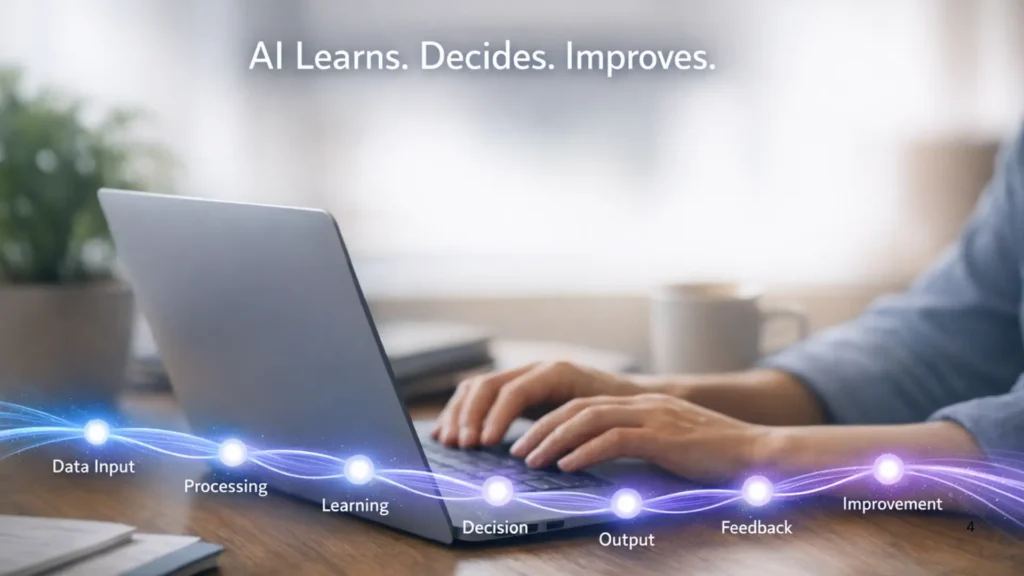
AI works through a continuous cycle of data input, processing, learning, and improvement. This cycle allows systems to analyze and make decisions and optimize performance over time.
AI starts by gathering relevant data from many sources: text, images, videos, or user interactions. This data is the basis that helps the system to understand patterns and relationships needed for specific tasks.
Before the learning process starts, the data that has been collected is cleaned and organised. Missing values, errors or irrelevant information are eliminated. Good preparation means that the system gets good quality input, which has a direct positive impact on accuracy and performance in real life applications.
During training, algorithms analyze the prepared data to find patterns and relationships. The system develops the capacity to predict, to recognize trends, to classify information and to be able to change its behavior without specific programs.
After training, the system deals with new inputs by comparing them with learned patterns. It makes sense of information, considers potential outcomes and makes informed decisions in real time based on probabilities and previously learned data.
AI produces outputs by applying learned patterns to new data. These outputs can be in the form of recommendations, classifications or predictions. They aid in automating tasks, decision making and providing users with relevant insights in many industries.
Once results are generated, then the system assesses performance against feedback and accuracy. Any errors or inconsistencies are then identified and the model can make changes to its internal processes so that it can handle similar situations more effectively in the future.
AI systems evolve by learning from new data and updated feedback. This continues process is the creation of refining the prediction, adapting to changing conditions, and maintaining a high level of accuracy in order to make the system ever more efficient and reliable.
Understanding AI becomes easier when you break it into core concepts that explain how systems learn, process information, and generate intelligent outputs in real‑world applications.
Machine learning lets AI learn from data without explicit programming. It uses algorithms that spot patterns, predict outcomes, and improve accuracy as more data becomes available.
Deep learning uses multi‑layered neural networks, inspired by the human brain, to handle complex data. This allows AI to perform advanced tasks like speech recognition, image analysis, and generative AI.
NLP allows machines to comprehend, interpret and generate human language. It powers chatbots, virtual assistants, translation systems, and AI‑driven content generators, all widely used in 2026.
Computer vision lets AI analyze and interpret visual data from images and videos. It is supporting applications like facial recognition, medical diagnostics, object detection and real-time monitoring in a wide range of industries.
AI can be classified by capability and function, helping explain how AI systems work today and how they may evolve in the future.
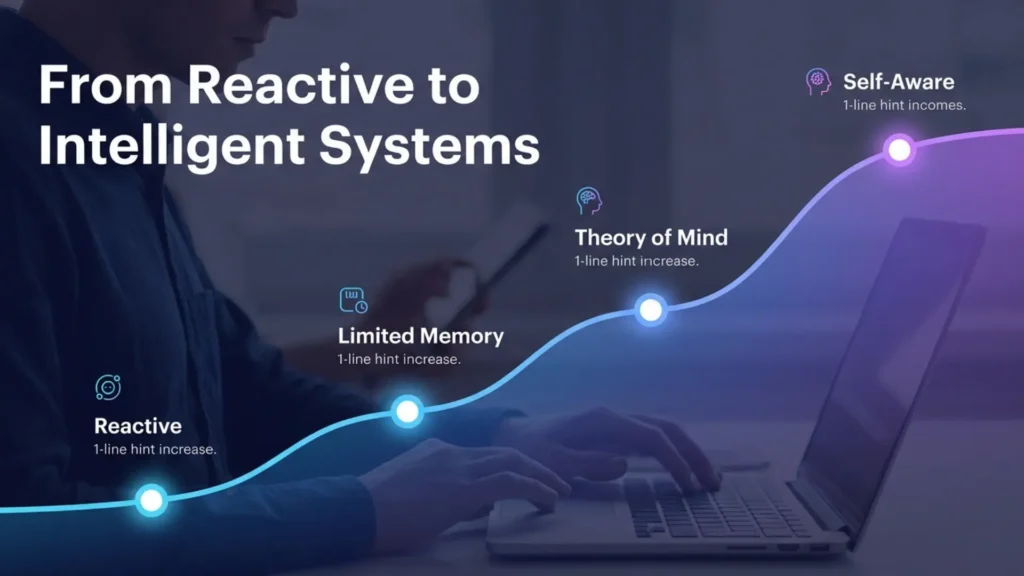
Reactive machines are the simplest form of AI. They only work on the present data and have no memory of past events. They react to certain input with predetermined logic, and have no ability to learn over time.
A famous example is IBM's Deep Blue which defeated a chess champion by not remembering past games and evaluating different moves.
Limited memory AI can learn from past data and use it to improve future decisions. These systems store information temporarily for greater accuracy.
For example, self-driving cars use recent traffic data, speed, and nearby vehicles in order to make safe driving decisions in real-time.
Theory of mind AI represents a more advanced concept where machines can understand human emotions, intentions, and social behavior. It is in the process of development. The goal is to improve human‑AI interaction by recognizing context and emotional cues.
For instance, future customer‑service AI could adjust responses based on a user’s mood, tone, or frustration level during conversations.
Self‑aware AI is a theoretical stage where machines would possess consciousness, self‑awareness, and an understanding of their own existence. This level of intelligence does not exist today but is often discussed in advanced AI research.
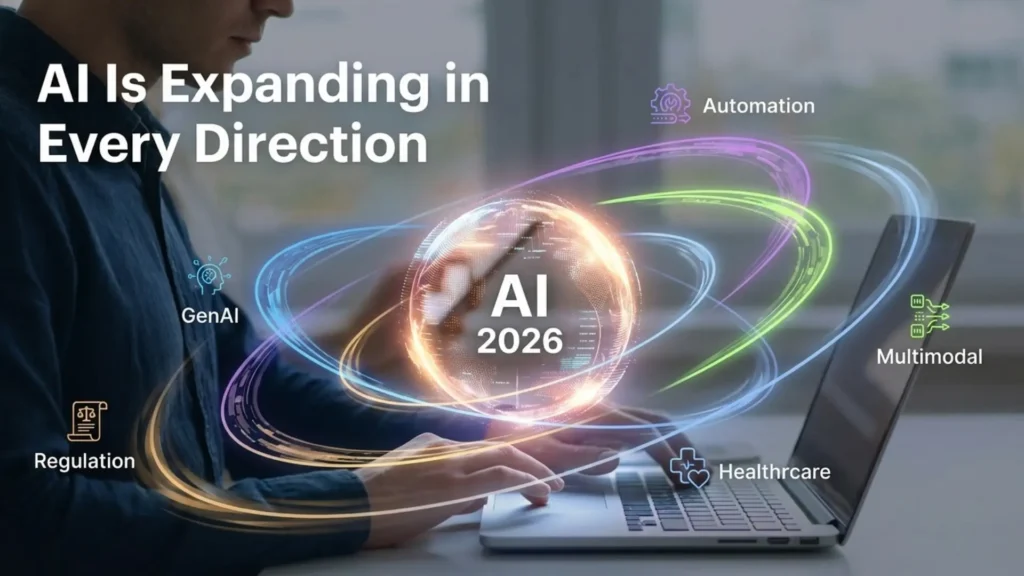
In 2026, AI is becoming intelligent, quicker and adaptable. These systems are capable of operating on their own, comprehending context in a deep manner and being able to integrate into the real world.
Today's AI is capable of planning and completing entire workflows by itself and improving the efficiency of digital operations.
Use Cases: Automating support tickets, backend process management, multi step digital task process management.
Technique: Goal-Oriented Execution- AI decomposes the goals into specific steps and completes them autonomously.
AI models now take several types of data in parallel, so they have a better understanding of the real world, and their output is more accurate.
Use Cases: Analyzing videos with audio Generating visuals from text Advanced search systems
Technique: Cross-input integration using text, visuals and audio signals in a cross-integration approach for richer interpretation.
AI systems are connected to external and real-time data sources to enhance reliability and reduce errors.
Use Cases: Internal company assistants, document-based chatbots, real-time analytics tools.
Technique: Context retrieval systems where AI gathers up relevant information before coming up with responses.
More AI executes on the devices themselves, lowering the latency and ensuring privacy by decreasing dependence on the cloud.
Use Cases: Smart wearables, mobile AI applications, industrial IoT systems.
Technique: Low weight model optimization enabling the efficient processing on low power hardware.
Users now control AI using natural language rather than code, accelerating development and increasing accessibility.
Use Cases: Creating apps with prompts, automating workflows, creating UI design
Technique: Context driven prompting where structured inputs steer the AI in terms of precise outputs.
AI tools are embedded in everyday business systems, enabling automation without deep technical skills.
Use Cases: Automated email sent, CRM updates, marketing workflows, task management.
Technique: System linking connecting AI to the existing tools to make them automated pipelines.
Monitoring systems ensure that AI outputs remain fair and secure as well as comply with global standards.
Use Cases: Detection of Bias, Compliance check, Risk management in AI decision making.
Technique: Nonstop auditing frameworks to test outputs for equity, accuracy and ethical alignment
AI systems are designed using specialized languages and frameworks that allow developers to create, train, and implement models efficiently across applications.
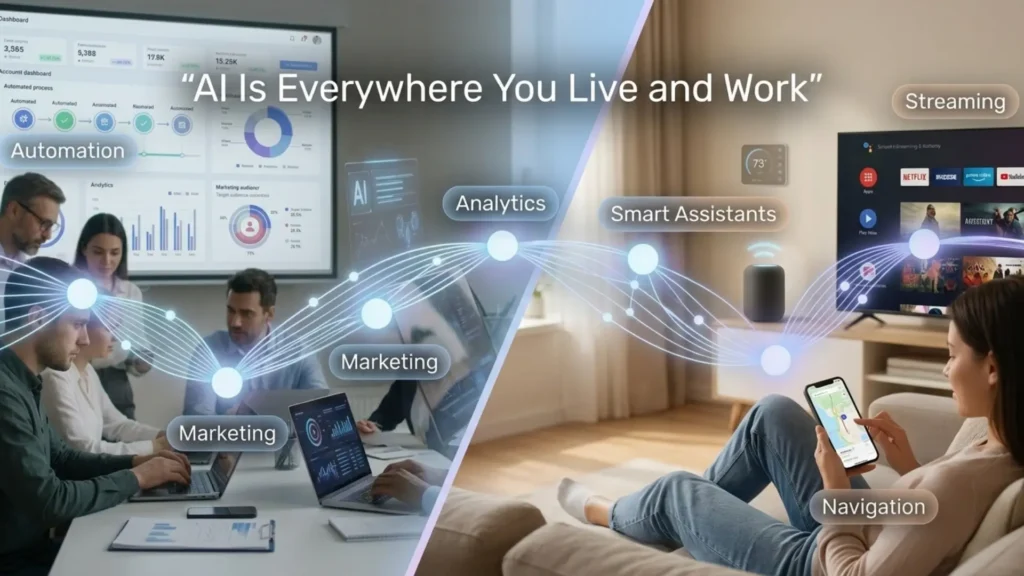
AI is present all around the industry and our everyday lives, automating processes and improving efficiency as well as providing personalized experiences in the workplace and home.
80% of customers have better experiences with AI chatbots, which makes them powerful tools for engagement, support and conversion.
So, how do you actually build one?
- Choose a platform like Chatfuel, Botsify, or custom AI tools.
- Train the bot using actual customer questions and data.
- Integrate it with your web site, CRM or messaging apps.
Testing is critical after the launch. Monitor the user interactions, identify the weak responses and continue refining.
A well-built chatbot does not just answer, it learns, gets better, and is a reliable 24/7 digital assistant.
More than 74% of companies are increasing their AI budgets in 2026. This reflects quick adoption and new thoughts throughout industries, day to day work and real world applications all around the world.
Artificial intelligence has great benefits for both businesses and everyday users, but it also has some significant limitations that should be aware before adoption. A balanced approach provides effective and responsible use.
Understanding both benefits and limitations helps businesses adopt AI in a strategic manner, minimize risks, and maximize long-term value.
AI works in a loop: it gathers the data, learns from the data, makes predictions and gets better at it. The cycle makes systems more smart, more precise and useful over the passage of time.
From simple automation to complex decisions AI is changing the way business is conducted. It increases efficiency, reduces manual labour and creates improved customer experiences on digital platforms.
When companies are aware of how AI works, they can use it in a smart way. They choose the appropriate tools, data and processes to address real problems and get results.
As generative AI and machine learning grow in 2026, firms that adopt early get a competitive edge and open new paths for innovation and growth.
Responsible AI is invaluable. Systems must remain transparent, fair and in line with ethics, and maintain trust between users and customers.
AI isn't here to replace people but to augment their abilities. It empowers businesses and individuals to work smarter, make better choices and build more efficient digital solutions.
AI is able to make decisions to take actions by itself using data and algorithms. However, these choices are based on set rules and learned patterns, hence human oversight is important to ensure that accuracy, ethics and reliability are kept under check.
AI requires lots of both structured and unstructured data - text, pictures, video and user activity. The data needs to be clean, relevant and high quality in order for the model to learn well and perform reliably.
Conventional software is executed by fixed rules that are written by developers. AI on the other hand learns from data and continually gets better. Because of this, AI is able to adapt to new information and tackle more complicated jobs.
Yes. Small firms can employ AI by purchasing inexpensive tools such as chatbots, automation tools and marketing aides. No-code ones allow them to deploy AI without profound technical skills.
Development time varies. A basic chatbot can be seen in a few days, but expensive projects - such as predictive models or custom AI platforms - can take weeks or even months to construct and fine tune.
AI is never 100 % accurate. Results depend on the quality of the data, the model architecture and the model training. Ongoing testing, updates and monitoring is needed for maintaining high confidence.




Let’s talk about how to take your product’s digital experience to the next level.


