


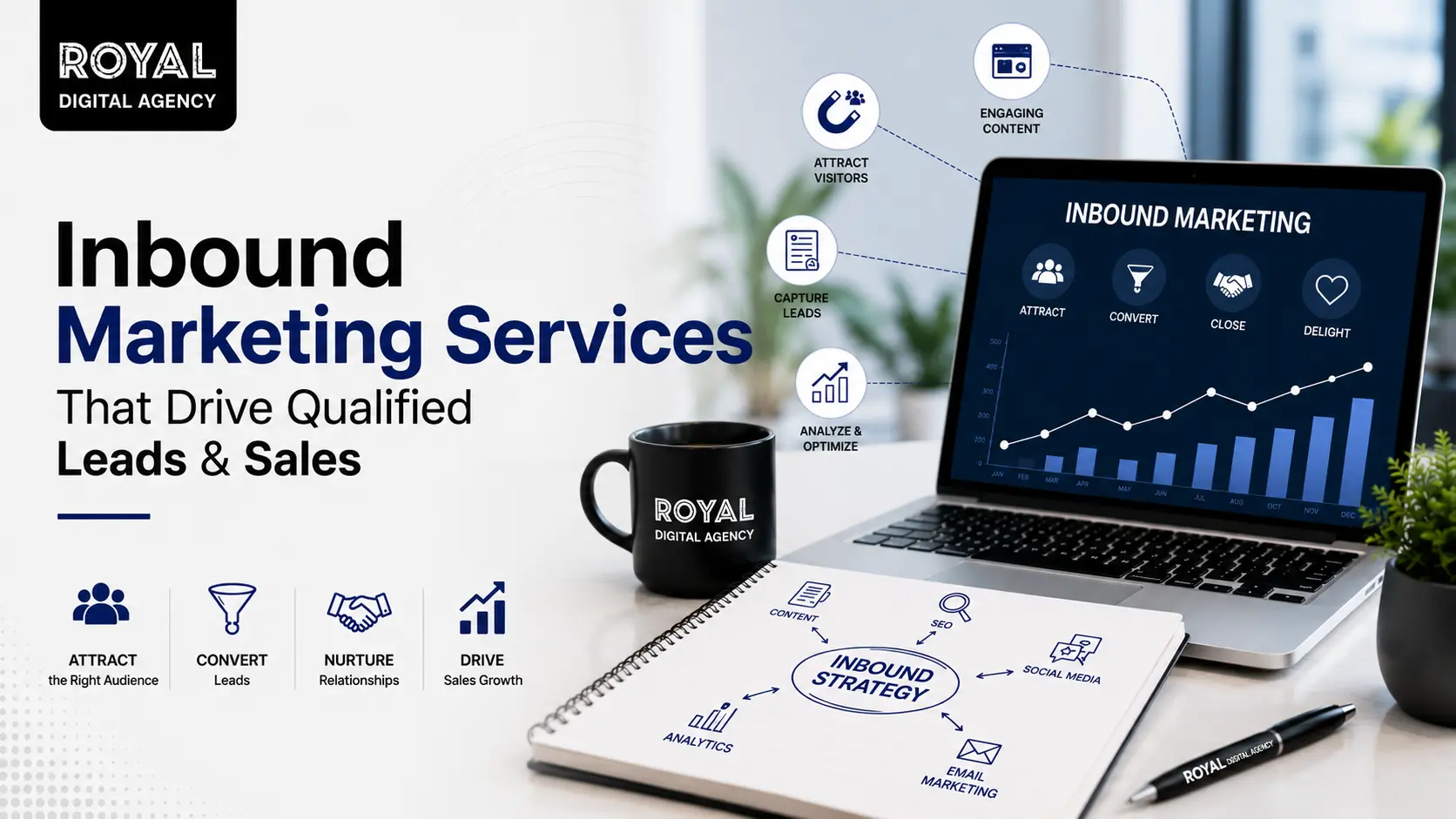
What happens when a website attracts traffic, but the sales team still struggles to find people who are ready to buy?
Growth doesn't only happen because of traffic. They require the proper visitors, a clear path to conversion, meaningful follow-up, lead qualification and a seamless handoff to sales. In HubSpot's 2026 research, 30.2% of B2B marketers found that website, blog, and SEO activity performed the best for ROI, while email marketing and paid social media were found to be 23.6% and 23.3% respectively.
Effective inbound marketing services combine these channels into one. These help individuals locate a business, comprehend its worth, transform into a qualified lead, and advance toward a purchase without a hard sell.
This guide explains the inbound marketing strategies, services, techniques, processes, and measurement practices that can turn online attention into qualified leads and sales.
Inbound marketing services are a coordinated series of digital marketing activities that bring in the right prospects, convert them to leads, develop a relationship of interest and nurture them until they are ready to buy, then assist in the post-sale relationship.
Common Inbound marketing services include:
The traditional advertising approach is to start by sending an email to a mass market. Inbound marketing starts with a question, challenge, goal or search from the customer.
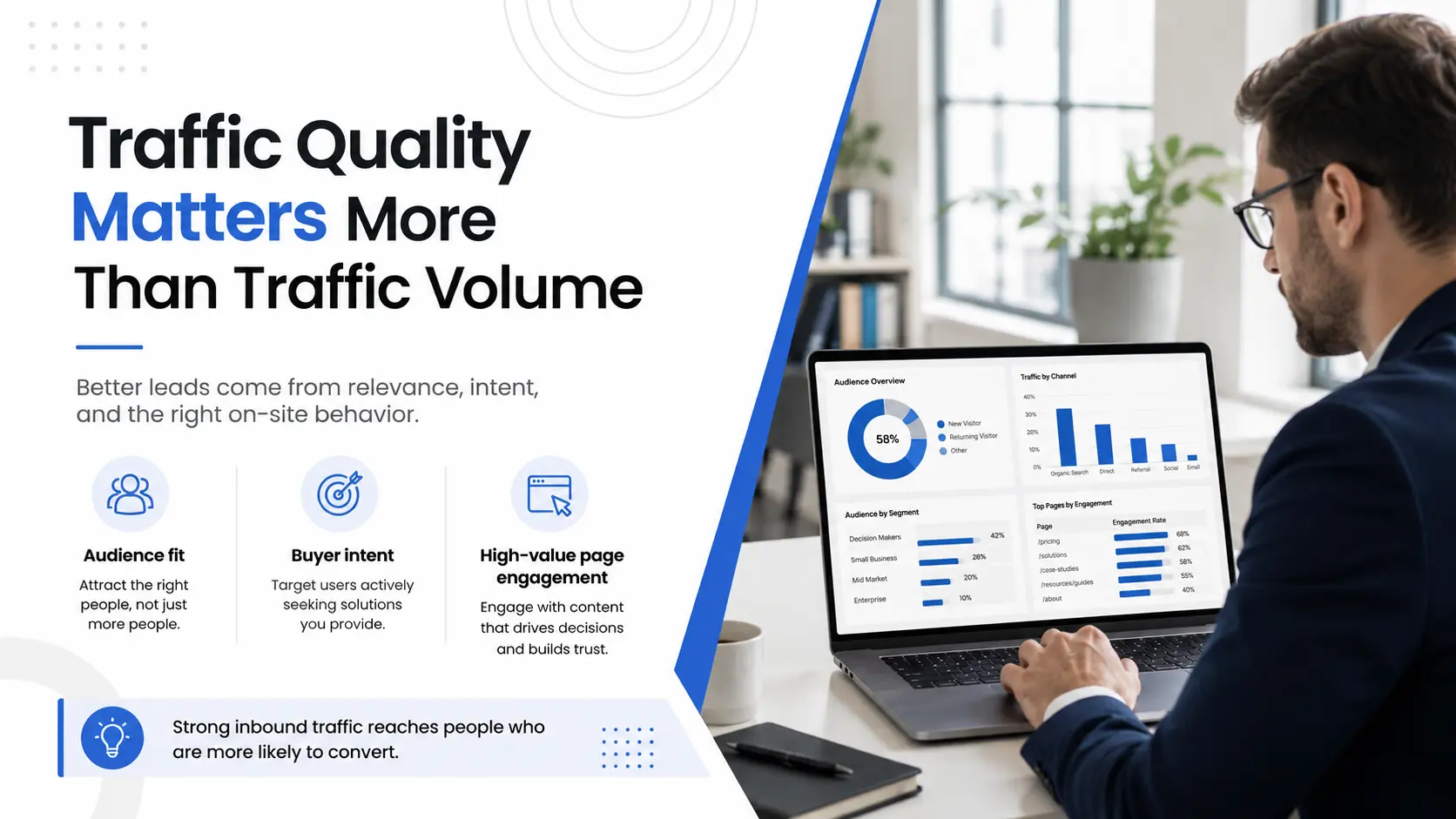
A website visitor who has been identified as having fit and intent is a qualified lead.
Fit refers to the extent to which the individual or company matches the ideal person. Intent refers to any activity that indicates a true interest, like viewing a pricing page, downloading a buyer's guide, a series of service pages, or requesting a consultation.
A blog subscriber who might be interested but isn't sales ready. If a decision-maker continually accesses commercial material and asks for pricing, he or she is well worth getting a quick call on.
How Inbound and Outbound Marketing Work Together
Combined Strategy: Both are viable options and can be used in conjunction. A combination of advertising, outreach, and introducing prospects to valuable content, focused landing pages, and planned follow-up.
Main Difference: Outbound provides instant visibility, inbound provides a system that educates, qualifies, nurtures and takes prospects to a decision over time.
Many purchasers nowadays do research on solutions prior to calling an agent. Inbound marketing is able to keep the business in sight throughout the journey, provide answers to key questions and help the prospect decide.
SEO, educational content, videos, social media, digital PR, and then some paid campaigns, drive relevant prospects to the brand's digital world.
The idea is not to be the most popular tourist destination. It's meant to be able to get to those who experience needs, questions or problems that the business can truly address.
Conversion pages have an obvious next action. Depending on the offer, they may:
Informative communication, easy forms, pertinent CTAs and prominent trust signals help make it easier to part with the money.
Not all the prospects that are interested are ready to purchase right away. The connection remains active thanks to helpful e-mails, case studies, reminders, videos and personalized resources.
Marketing automation can provide follow ups that align with a lead's interests or actions. This allows the business to determine more effectively where it can identify better opportunities without sending out the same message to everyone.
Inbound marketing continues after conversion. The resources, educational emails, FAQs, customer support, surveys and referral campaigns make for a better customer experience.
The post-purchase experience can boost retention, drive reviews, generate referrals, and foster repeat sales.
An inbound system requires a number of services to be in sync to achieve a common business goal.
Any inbound marketing efforts start with customer research.
A business needs to understand:
Financial decision makers, technical reviewers, users and senior leaders might require different content in B2B companies. An individual message is not typically appropriate to the needs of a whole buying group.
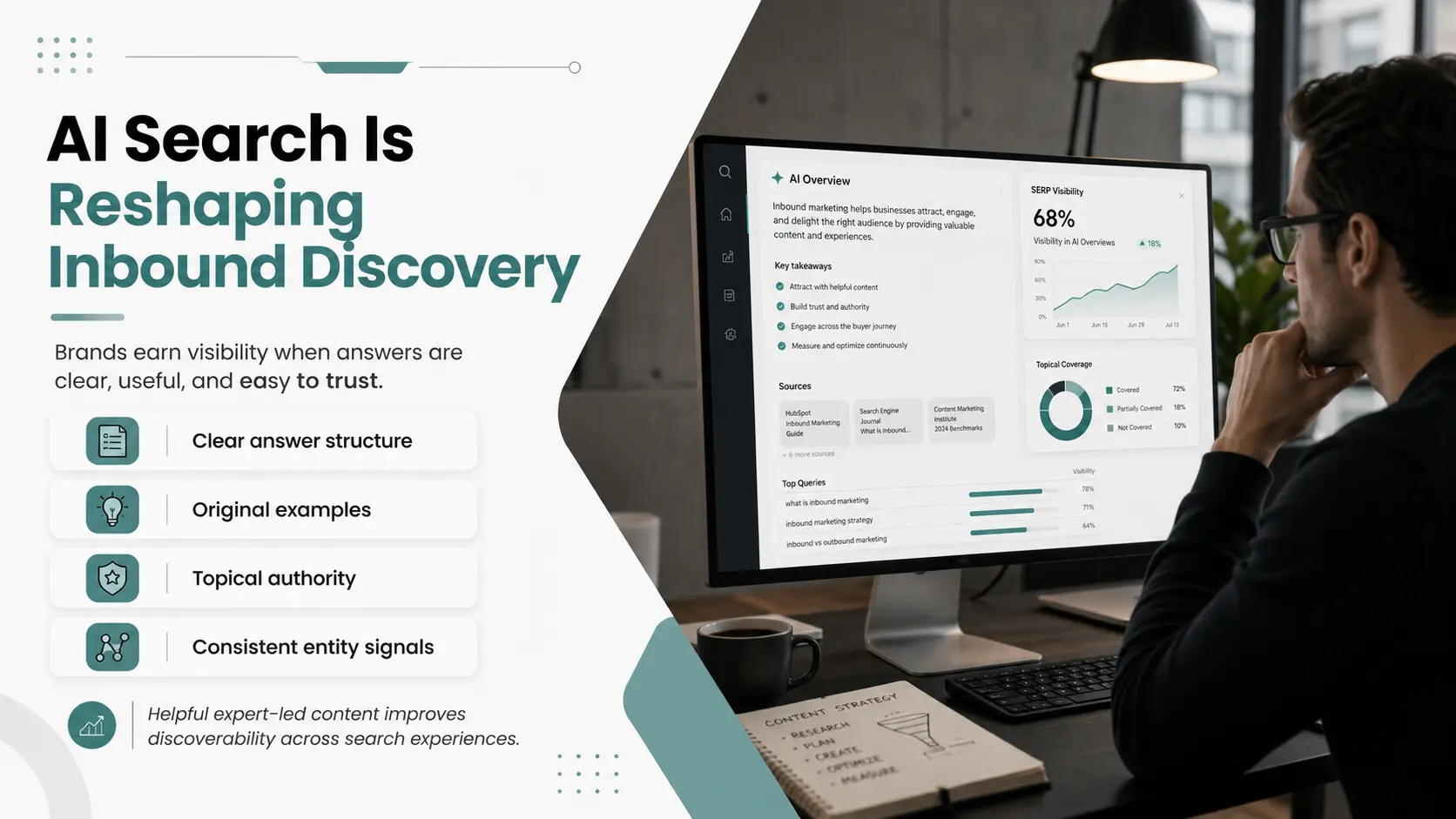
A business can come up when someone is looking for information, a service, comparisons, or a solution by having a lead generated through SEO.
A complete SEO program may include:
The role of AI-powered search in 2026 is significant. Google states that its established SEO guidance still applies to AI Overviews and AI Mode. Creating original, useful, expert-based content is the most important priority for businesses, not special AEO or GEO tactics.
Good pages have answers to real questions, have first-hand knowledge, have clear headings and are easy to find by search engines. For pages to be included in generative search experiences, they need to be indexed and be able to be found in the standard Google Search.
Customer inquiries are converted into valuable content with content marketing services.
The various formats are suitable for various phases of the journey:
Buyer Stage
Useful Content
Awareness
Blog posts, educational videos, guides, and social content
Consideration
Webinars, checklists, case studies, and comparison pages
Decision
Demos, consultations, ROI tools, testimonials, and pricing information
A blog post can bring about someone looking for an answer. That visitor can then be converted to a lead by using the relevant checklist, assessment, calculator or guide.
Only 29% of the B2B marketers surveyed said their content strategy is 'extremely effective' or 'very effective,' with 58% indicating it was 'moderately effective. Only about one-third reported having a scalable content creation model.
The opportunity is not simply to publish more. There is a need to develop a more powerful skillset, set of objectives, case studies and better alignment of content to conversion.
A website has to be more than just a professional-looking website.
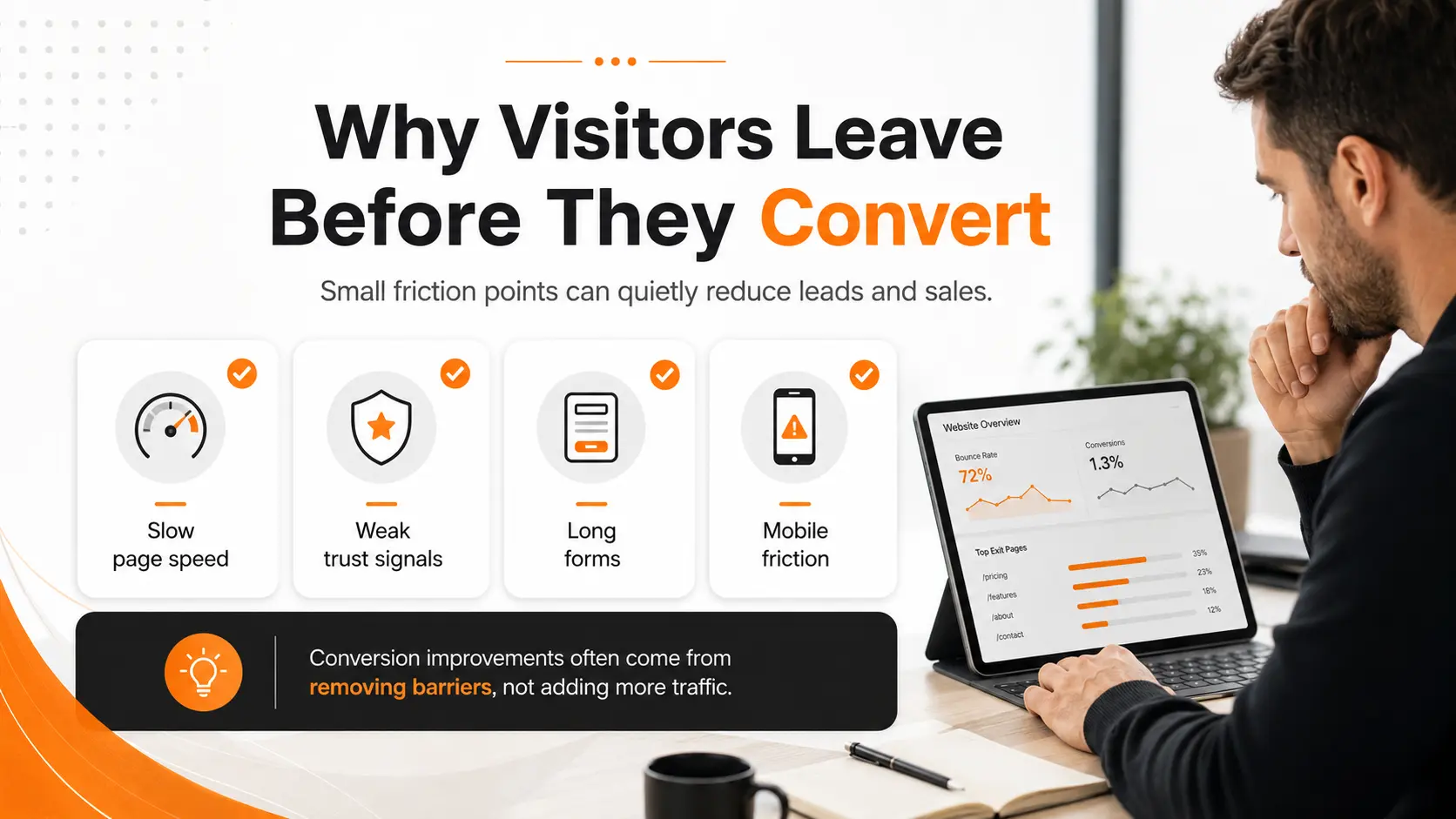
CRO services enhance the behavior of visitors through key pages. Work may include:
A good landing page will clearly outline one offer, articulate the offer's value, preemptively tackle the prospect of any questions, and require a simple action.
Email allows a business to go on with the conversation after the visitor leaves the website. Useful automated sequences may include:
Communication should be more relevant and more human than ever thanks to automation. Industry, service interest, behavioural and lifecycle segments help to stop irrelevant messages from reaching the right people.
In 2026, HubSpot revealed that three-quarters of marketers were leveraging AI to craft content and 75% were using it to produce media. Human review, brand knowledge and fact checking are still very important since automation can amplify poor content as well as good content.
A CRM system tracks the interactions of leads with the business. Lead scoring can assign value to signals such as:
The scoring system should identify casual readers from good prospects. It's also important for marketing and sales to have common definitions for marketing qualified leads, sales qualified leads, response times and reasons for rejection.
A strong handoff provides sales with context such as pages viewed, resources downloaded, sales signal problems researched, and actions that generate the sales signal.
If the right people don't see the useful content, it will not accomplish anything. Social media allows businesses to distribute:
For B2B brands, Linkedin and YouTube are good options for targeting decision makers. Short-form video or Instagram or Facebook could be more important for companies with local or consumer audiences.
In the 2026 research, HubSpot found that short-form video reported the highest ROI across all media types, with 48.6% of the respondents reporting it as being in their top three.
The distribution should be as the platform. Rather than posting the same content in the same format, context, opening, and call to action, companies must tailor these to specific elements.
Paid media can accelerate an inbound marketing system. In the case of search ads, they get to those who have an immediate intent. Guides, webinars, case studies and videos can be shared with targeted audiences on paid social media campaigns. Retargeting can reach out to those who looked around your website but didn't take any action.
The same qualification and nurturing process should be used for paid traffic as for organic traffic. Only measuring the cost of form submissions can mask bad leads.
The B2B inbound marketing solutions frequently need to be able to back a number of people in the same firm or organisation. ABM is a strategy that targets high-value accounts. Content may be personalized by:
Sales enablement materials are used to keep the dialogue going with the sales representative. Useful assets include:
The metrics should be the account engagement, opportunity progress, sales adoption and revenue impact.
When the team is able to see what impacted actual business results, they can make inbound marketing easier to improve.
Reporting should connect:
Customer Journey can be broken down into different aspects, such as Google Analytics 4, Google Search Console, advertising platforms, CRM tools and call-tracking tools.
While vanity metrics may be used to aid diagnosis, pipeline, customer and revenue metrics should inform strategic decisions.
Activity can be accomplished without generating a reliable growth system with an isolated tactic.
One possible inbound funnel sequence is as follows:
When there are disconnections in execution it causes predictable problems. Visits but limited inquiries is a lack of conversion paths in SEO. When it comes to paid ads, if they don't have a compelling landing page, then the money is being spent in vain. If there's no segmentation, then irrelevant messages are sent. Unqualified lead generation provides sales teams with leads rather than opportunities.
Relevance, timing, and context are all crucial factors for qualified lead generation.
Search intent is used to draw in those who are already looking for a problem related to your search. Content enables them to assess the business prior to reaching out. Conversion behaviour indicates their interest, and CRM data offers a history of engagement.
Lead scoring is a combination of fit and intent. Then, sales feedback will refine the model to identify which leads turned to opportunities, which were rejected and why.
The result is not simply a larger database. The objective is a pipeline that has people who are informed, relevant and better prepared for a helpful sales dialogue.
Inbound marketing agencies can create leads as well, but their approach and objectives can vary.
An inbound marketing agency builds a complete attraction, conversion, and nurturing system, while a lead generation service focuses on producing leads or booked appointments. Inbound marketing uses SEO, content, CRO, email, automation, CRM, and paid media, whereas lead generation relies on outreach, advertising, list building, or appointment setting.
Inbound marketing plays out over the medium to long term and usually builds first-party data, while lead generation is faster-focused, with data ownership depending on the provider. On the sales side, inbound marketing supports nurturing, scoring, attribution, and enablement, while lead generation focuses on qualification or appointment delivery.
In short, inbound marketing is best for sustainable demand and stronger brand visibility, while lead generation is best for faster lead volume on a defined offer.
Some lead providers use shared or low-quality leads. Companies should inquire into the source of the data, how it is being gathered, if any data is exclusive and if any leads are verified to be good.
If an in-house team needs strategy, audits, training or supervision, inbound marketing consultants are appropriate. A typical inbound marketing agency will have more people in its delivery team, ranging from content creation, SEO, design, paid media, automation, to reporting.
Inbound marketing best practices are all about customer value and measurable results.
Develop topics, pages and offers based on actual questions and problems, buying triggers and objections. Search volume alone does not prove commercial value.
The content of awareness should be educational. Content for consideration should enable comparison of the solutions. Content for the decision stage should minimize risk and clarify what action is to be taken.
Departments can't engage in different versions of the customer journey because of data sharing, lifecycle definitions, lead scoring, handoff rules and reporting.Use Expert-Led Content
Google recommends content that provides original information, demonstrates first-hand expertise, cites reliable evidence, and gives readers enough information to achieve their goal. Google also identifies trust as the most important part of EEAT.
Authors, expert reviewers, real-life examples, original graphics, and real case studies can help to make content more useful and credible.
Review landing pages, calls to action, email performance, lead quality, search visibility, and sales outcomes regularly.
Google also advises against fast fixes and suggests that it might take days or even months to make improvements that will impact search performance. Rankings are not absolute and stable.
Track the performance throughout the entire funnel.
This trend towards automation and connected customer data is expected to continue in future investments. In 2026, Grand View Research projected the marketing automation market to be worth $8.4 billion, and is predicting it will be $15.6 billion by 2030. The forecast is a compound annual growth rate for 2025-2030, and is not a promise.
A good inbound marketing partner should know how strategy, campaigns, the quality of leads, sales opportunities and revenue are related.
Look for experience in:
When looking for an agency or consultant, ask:
Ensure that your business still has the ownership and use rights over:
Be cautious of agencies that offer:
A good inbound marketing agency should be able to articulate its value in bringing in targeted leads, nurturing qualified opportunities and driving quantifiable growth for a business.
How Long Inbound Marketing Takes and What Affects Cost
Inbound marketing takes time to build up since different channels will result at different speeds.
With paid campaigns, you can get leads and traffic right after your campaign goes live. Once prospects enter into a workflow, email automation can start helping them. Its acquisition typically takes longer and a regular investment of time, effort, and money in SEO, content authority, backlinks and organic visibility.
Several factors that affect the time and cost of the job.
A few different factors can affect how long a project takes and what it ends up costing. If a website has technical or conversion issues, that can slow things down, and fixing them through redesign or development work adds to the initial cost. In competitive industries, it usually takes more time to stand out, which often means investing in extra content, SEO, and paid media. Brands that already have some authority tend to gain traction faster, while newer brands usually need to put more into building that up.
Good content takes time too — real research, writing, editing, and approvals all add up, and the more you need, the more it costs to produce. When it comes to longer or more complex sales cycles, customers need more nurturing along the way, which means more content and automation to support them. Setting up CRM and automation tools can also stretch out the timeline if the setup is advanced, and things like integrations and workflow complexity add to the cost.
A bigger ad budget helps you get performance data faster, though that spend is separate from creative and management costs. And finally, how quickly your team reviews and approves things matters a lot — slow feedback can hold up launches, and extra rounds of revisions can eat into your budget.
The contents of a reliable proposal.
Your inbound marketing proposal should include the following:
Any reputable agency or consultant will not guarantee a number of leads or sales, or even rankings, by a specific date. The proposal should include a way to measure the progress and how the strategy will change as reliable data is available.
Inbound marketing underperforms when strategy, content, sales, and measurement are disconnected.
Successful inbound marketing does not rely on one channel. SEO creates visibility. Content builds trust. Conversion rate optimization turns attention into action. Email, automation, and CRM processes nurture and qualify leads. Analytics provide information on activity that leads to pipeline and revenue.
Businesses can integrate digital marketing services into a logical, qualified lead-centric, sustainable growth framework with the help of Royal Digital Agency.
Check out Royal Digital Agency's inbound marketing solutions or get a strategy consultation to see where customers may be falling out of your funnel.
Inbound marketing services commonly include strategy, SEO, content creation, website optimization, landing pages, email marketing, automation, CRM management, lead scoring, social media, paid promotion, sales enablement, and reporting. The proportions should be based on the audience, sales cycle, existing marketing opportunities and business objectives.
The most effective inbound marketing strategies are the ones that are more in line with customer intent. High-quality SEO content pages, comparison content, case studies, lead magnets, webinars, email nurturing, calculators and conversion-focused landing pages can all lead to great leads. Results are dependent on industry, quality of execution, audience and offer.
Yes. Inbound leads can be achieved via SEO, content, referrals, email, social media, webinars and organic distribution. Test offers and reach can be achieved through paid advertising but that's not mandatory. This can take longer with organic growth, particularly in competitive markets or if the website has a low authority.
A marketing qualified lead is one that has demonstrated a level of fit and engagement that indicates that the lead is a good fit for your business. A sales-qualified lead has met the company’s criteria for a direct sales conversation. Clearly defined marketing and sales definitions should be agreed by both departments based on role, company fit, behaviour, intent, readiness.
A company can always use a marketing consultant when they need strategy, an audit, training for their team, technology advice, or to solve a particular problem with their funnel. If that's the case, an agency might be more suitable if the company requires consistent execution in every other channel, such as SEO, content, design, paid, automation and analytics.
Yes. It's simple that small businesses can start out with a targeted site, local search, helpful service pages, customer reviews, a simple lead magnet as well as basic email follow up. The program can be scaled up to include more results and resources. Many marketing activities are better served by a smaller well connected system.
Check on critical content whenever there are changes in facts, services changes, rankings drop, customers questions change, or the page no longer converts. Service pages of high values and major guides should be performance-tested regularly. Changes which don't really add any value to readers and search engines aren't really worth it for a date.
There is a simple calculation that subtracts inbound marketing expenses from the inbound marketing revenue and divides by the marketing expense. Aside from the potential constraints of the attribution model used, sales-cycle length, CAC, repeat revenue, assisted conversions, and reliable ROI should all be taken into account.



Let’s talk about how to take your product’s digital experience to the next level.


