


What is the next video your business creates supposed to accomplish?
The answer is important because increasing content doesn't mean increasing quality. A video might get thousands of views, but produce no qualified leads, and a targeted product demo can get less attention and still close a great sale. Results-driven video production services begin by defining the job of the video before planning the script, visuals, or filming.
Video is already part of most modern marketing strategies. According to Wyzowl's 2026 survey, 91% of businesses leverage video marketing, with 82% of video marketers reporting a good ROI. The same study correlated video to improved customer understanding, website traffic, lead generation and sales. The above figures are based on the views of 266 respondents and, therefore, are not guarantees but rather industry indicators.
This guide covers what services are included in what types of productions, which formats align with which objectives, how video is made, and how businesses can evaluate a video's meaningful performance.
Video marketing services include strategy, planning, production, distribution and measurement, and help a business achieve a specific goal. It can be about raising brand awareness, describing a service, obtaining leads, assisting sales, customer onboarding or conversions.
The service is more than just filming and editing. A full strategy defines an audience, a message, the stage of the customer journey, placement, the action you want the audience to take and the success metric before production starts.
A production team might create a polished final video, but in the absence of planning on where and what the asset will do after it's published, it may fail to perform as intended. The best video content marketing services combine creative with distribution, sales objectives, web performance and campaign measurement.
A complete engagement may include:
Video can be used to demonstrate a product, explain a complex process, introduce the people behind a company, or answer questions prior to a sales call. Familiarise an unfamiliar offer with a combination of voice, movement, demonstration and visual examples.
Clarity also reduces friction. People who are aware of the service, the process to be expected, and the likely outcome will make a better informed decision. Sales teams can dedicate less time to repetitive information and more time to talking about the needs of the customer.
The investment on digital video keeps growing. IAB projections include:
Forecasts also suggest further growth over the longer time frame but should not be regarded as a guarantee. Grand View Research projections include:
After 2026, the opportunity won't only be based on the biggest company. With the rise of video, businesses will require more robust strategy, channel-specific versions, human creative direction, accessible content, and measurement tools.
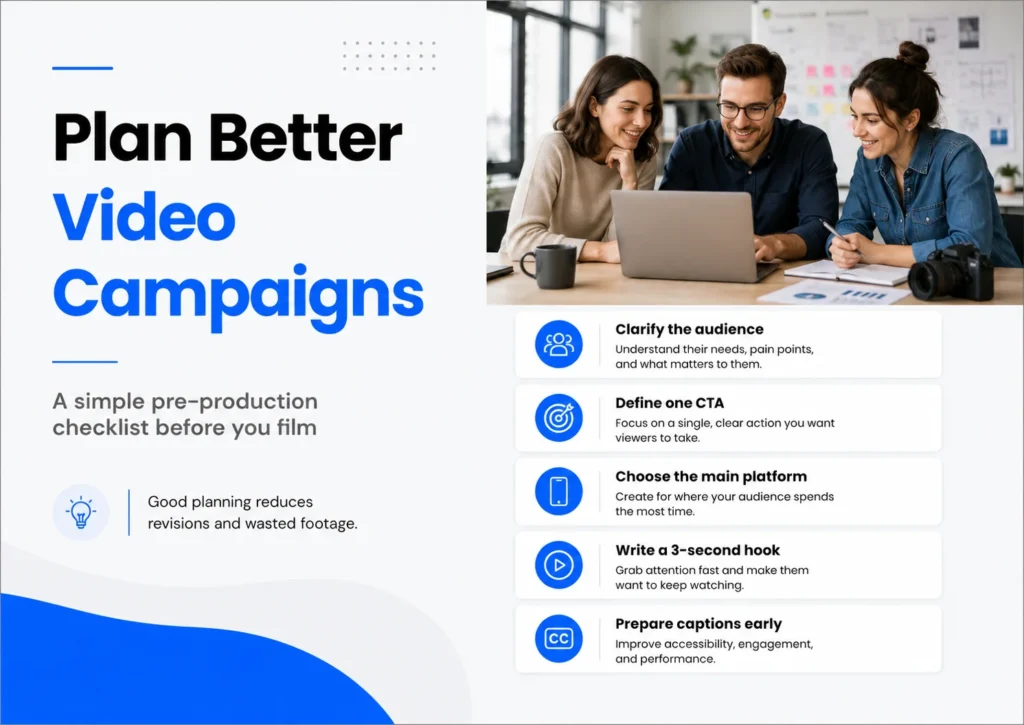
The following six questions are useful to begin a useful strategy:
Your brand video that plays on your homepage should be different from your retargeting ad. The first can set up trust and positioning, the second can be one of the concerns and can motivate a high intent action.
Multiple coordinated assets can be created in one filming session. An interview with a leader can be a brief introduction to the company, some educational content, a sales post, a social post, and a mini ad.
Consistency and wasted footage can be avoided by anticipating this system in advance of production. Then the brand videos, education and conversion videos complement each other rather than compete for the attention.
Brand videos convey a company's values, whom it serves, and what they believe. They can be company overviews, stories about the founders, mission-driven content, team introductions or leadership interviews.
Establishing a credible brand video early on will make future marketing messages and sales conversations more effective since prospects know the brand and its values.
Educational videos deliver valuable information that enables the audience to grasp a concept, address a problem, or make an informed choice. These come in the form of FAQs, webinars, tutorials, expert interviews and industry insights.
In sectors where trust and information play a crucial role in the purchasing process, like healthcare, finance, technology, and professional services, these videos can be particularly useful. They also help with the continuous marketing by providing content to blogs, email marketing, social media and sales enablement.
Explanatory videos convert complex products, services or processes into visuals. Motion Design is especially effective when dealing with abstract concepts, technical systems or data which is not easily filmed.
Any workflow, system integration or product functions can be illustrated in a structured manner using animation. Motion graphics also can highlight important details and focus the viewer's attention.
Product and service demonstrations illustrate how an offering is used in the real world. These can be configuration instructions, screenshots and navigation guides of the interface, or a progression of the customer experience.
These videos minimize 'fear of the unknown' and help build confidence and better inform the decision-making process.
Testimonials are short customer feedback statements and customer success stories are longer stories. A successful video should describe the problem, the help offered, how it was done and the outcomes.
Specific, authentic examples are more persuasive than general praise. Clear outcomes and real experiences enable prospective customers to asses if their needs are going to be met with the solution.
Conversion and sales videos aid in decision-making later in the customer's journey. They can be videos on the landing page, objection handling videos, videos on pricing, proposal videos, and custom follow ups.
Their effectiveness lies in the ability to take action on their concerns and lead the high intent viewer to the next action.
Short video clips are attention grabbers and convey a clear message. They may introduce a concept, draw attention to a particular point, provide a single question or guide viewers to more in-depth information.
Formats such as Reels, Shorts, TikTok, and LinkedIn clips are most effective when they are part of a broader strategy, connecting to longer content or conversion-focused assets.
There are generally five sequential steps to professional marketing video production.
Pre-production is frequently the least apparent phase, but just as important in safeguarding the message and the budget. Weak planning can lead to missing footage, unclear interviews, delayed approvals, or costly revisions.
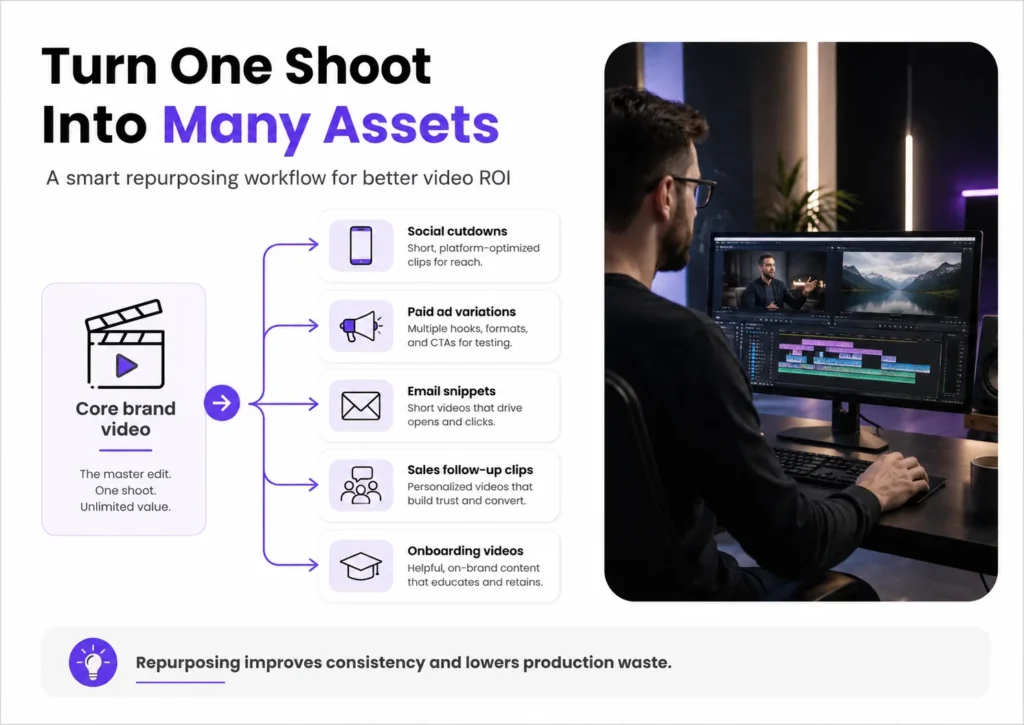
A well planned production day can produce a video for the homepage, a demonstration for services, interviews with customers, advertising and a library of short clips. When recorded with future placements in mind, editors can generate horizontal, square and vertical versions without compromising image quality or clarity.
Live-action video adds the human touch and motion design adds clarity.
For example, a software company might incorporate a video of a founder interview, animated product screens and customer-result graphics. A real consultation video with static motion graphics showing their process could be used for a professional service company.
Strong Video & Motion Design Services select the format based on the message. Animation should not be used solely for decoration; and in live action, a live action shot should not be used when it makes an idea more difficult to explain.
After the initial cut has been accepted, online video marketing starts. Distribution helps to define who will view the content, how it will be viewed, and the action they are given to take next.
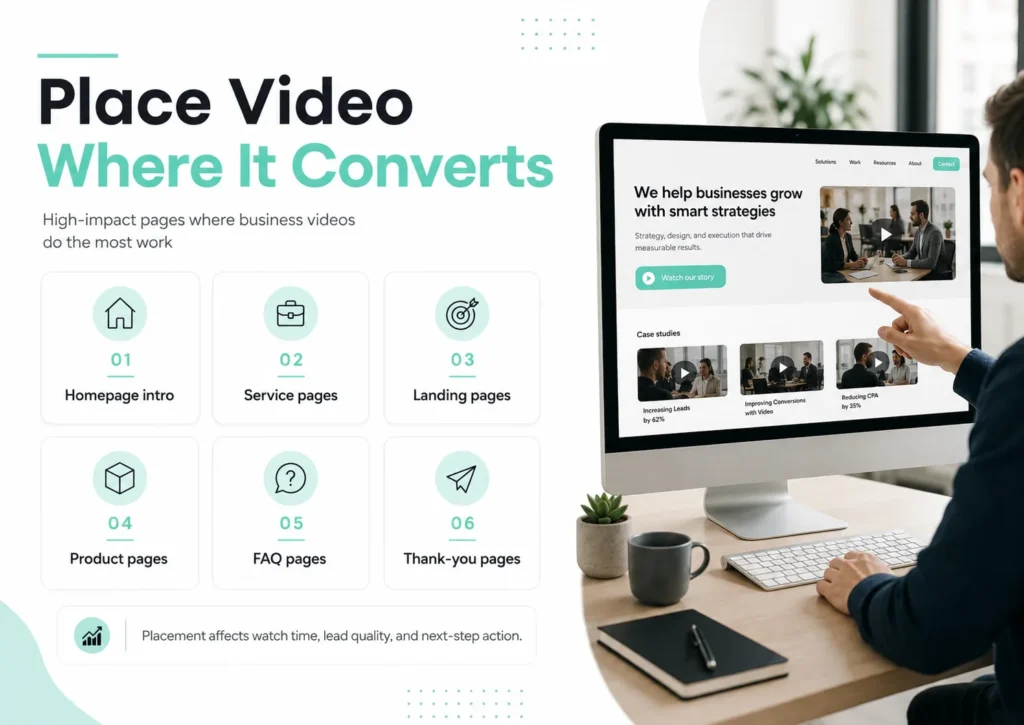
While the results can differ depending on group and industry, according to Wistia's 2026 study, 80% of B2B teams said LinkedIn is their top video-sharing platform.
These practices are useful for search engines to interpret contents of video, but do not ensure better search visibility.
Captions improve accessibility for viewers who are deaf or hard of hearing and enhance the overall user experience.
A view is not a business result, but rather a video event. The performance should be judged on what it is attempting to achieve in relation to the video's objective.
Video goal
Useful performance indicators
Awareness
Qualified reach, branded searches, direct visits
Education
Watch time, completion rate, page engagement
Lead generation
Clicks, form starts, booked calls, qualified inquiries
Sales
Purchases, proposals, assisted conversions
Onboarding
Completion, product adoption, reduced support requests
Retention
Renewals, repeat engagement, customer satisfaction
Either case study or limited views might lead to good closing of high value deals and a social video that is widely shared can lead mostly to visibility of the brand. When they serve the purpose it can be both outcomes.
A structured measurement approach may include:
With Google Analytics, you can track traffic sources using campaign parameters and you can get attribution data from multiple touchpoints. But not all influences on a customer's decision will be represented in the attribution models.
Video marketing ROI = (Revenue attributed to video − total video cost) ÷ total video cost × 100
When it comes to brands and educational marketing, impact can go beyond conversions. Some metrics can be better indicators, including lead quality, shorter sales cycles, better customer understanding, and greater internal usage.
Video marketing tools can be used to assist in every stage of the process, from planning to production, distribution to measuring results. They can help to make things more efficient and consistent, but they are only effective if there is a clear strategy and business goals.
AI is increasingly being used for video content, from writing the script to editing, transcription, and repurposing. In 2026, 63% of surveyed marketers indicated that they utilized AI tools for video production or editing, and Wistia discovered more than one-third of teams had adopted AI, particularly in the initial planning stages. These numbers do show an increase in adoption but will depend on the size of a team, budget and technical skillsets.
Human oversight remains essential. Creative direction, storytelling, brand alignment, and audience sensitivity require judgment that tools alone cannot provide. Video marketing that is both effective and impactful is made up of technology and human insight.
Video marketing costs depend on the scope of work required to achieve a specific goal. The pricing is not solely determined with the length – strategy, complexity of the production, distribution all play a part in the final investment.
Important cost factors include:
Pricing model
Best fit
Main consideration
Project based
One campaign or defined asset
Changes may expand the scope
Hourly
Editing or flexible support
Final cost may be less predictable
Retainer
Ongoing production and testing
Requires consistent monthly need
Campaign package
Several connected assets
Deliverables must be clearly defined
The Wistia 2026 report revealed a wide range of company production spending. Almost 40% of surveyed companies spent under $5,000 producing videos during the previous year, while just over 30% spent above that amount, and the remaining companies did not separate video into a clear budget.
The polished portfolio demonstrates visual skills, but doesn't necessarily reveal the entire process. The best video marketing agency should comprehend the business situation prior to suggesting a format.
Ask potential partners:
It's better to have a great reel with no context than a great reel with some context. Identify examples that demonstrate the client's problem, creative decisions, distribution plan and measurable outcomes.
Communication, strategic thinking, accessibility, timelines and post-launch support are all important factors to consider when comparing video marketing companies.
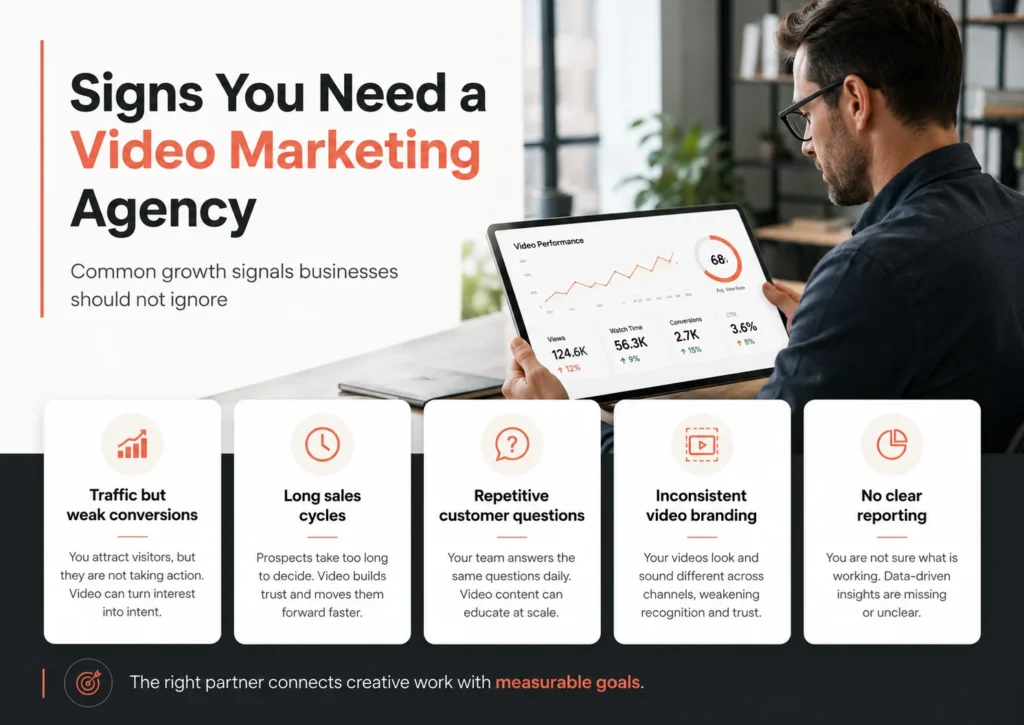
Service indicators include the same recommendations for all clients, too much emphasis on camera equipment, no mention of distribution, lack of clarity regarding deliverables, and impressions or likes only.
A freelancer could be a good option for a smaller, specific job. An internal team is ideal for regular production, and an agency is a good option for a wider range of services such as strategy, production, animation, editing, and campaign support.
Royal Digital Agency sees video as strategic growth material – not content in its own right. It ties planning, production and distribution to the quantifiable business outcomes.
All projects start with a solid base. The team specifies the target group, business goal, customer problems, distribution channels and action video they wish to achieve; allowing each video to play a particular part in the overall marketing system.
Creative decisions are made according to the strategy. Live-action Video Production, editing, branded visuals, and Motion Design Services are selected based on what communicates the message most clearly and effectively for the intended audience.
Productions are planned to generate multiple assets rather than a single video. The value of each project is extended with Core footage's structure to be used across various platforms such as websites, social media, adverting, email marketing and sales materials.
Distribution is taken into account from the beginning. Videos are tailored for various platforms, formats and audiences to ensure the same message is delivered and maximize reach.
Continuous improvements are based on performance data. All of this engagement, viewing activity, lead quality and conversion activity can help fine-tune content in the future and boost results over time.
The agency creates video solutions that not only allows brands to grow sustainably but also educate customers and generate revenue, all part of a bigger, long-term strategy.
The key to a successful video strategy is finding out where customers need more clarity, trust, proof or direction.
Royal Digital Agency combines strategy, Video Production, editing, and Video & Motion Design Services to create assets with a defined business purpose. Each piece of content is planned to support websites, campaigns, social channels, sales workflows, and long-term brand growth.
Explore Royal Digital Agency’s video and motion design capabilities or get in touch to discuss which video assets can best support your next stage of growth.
Video marketing involves the strategy, planning, production, distribution and measurement of video content for business-specific purposes. They can involve scripting, filming, animation, editing, platform optimization, as well as analytics. A comprehensive strategy makes sure every video is connected with a clear audience and goal.
Video production is concerned with the production of the visual product, which involves shooting, animation, sound and editing. Video marketing is about the production but it also covers the target audience, goal, platform and metrics. Production is the creation of the content and marketing is the delivery of the results.
The best type of video depends on the customer's stage of the journey. Brand videos build awareness, educational content establishes authority, demonstrations improve understanding, and testimonials build trust. Conversion videos encourage action, onboarding videos help to retain customers.
Depending on complexity, the production timeline will differ. Simple videos could take a couple days, and larger projects or animation can take weeks. Scripting, approvals, shooting logistics and revisions all impact the time. Pre-production planning is very important to avoid delays.
Costs vary according to the amount of work, strategy, production needs, locations, talent, animation, editing, and deliverables. Prices can come in a variety of forms, such as project-based, per-hour, or retainer-based. The best estimate is one that is clearly defined.
ROI is measured based on the video’s objective. This can include metrics like leads generated, conversions, revenue, customer retention, watch time, and click-through rates. The most applicable metric will be one that is directly linked to the goal of the video.
Absolutely, if it's planned ahead of time, one production can be adapted to be suitable for several platforms. Version variations can be developed for web sites, social media, advertising and email. Optimizing format, length and messaging by platform enhances performance.
Motion design can be very helpful when trying to convey something more complex like data, software or a process that can't be visually demonstrated through live footage. It can also add graphics, text, and visual elements to videos, making them more engaging and easier to understand.



Let’s talk about how to take your product’s digital experience to the next level.


