


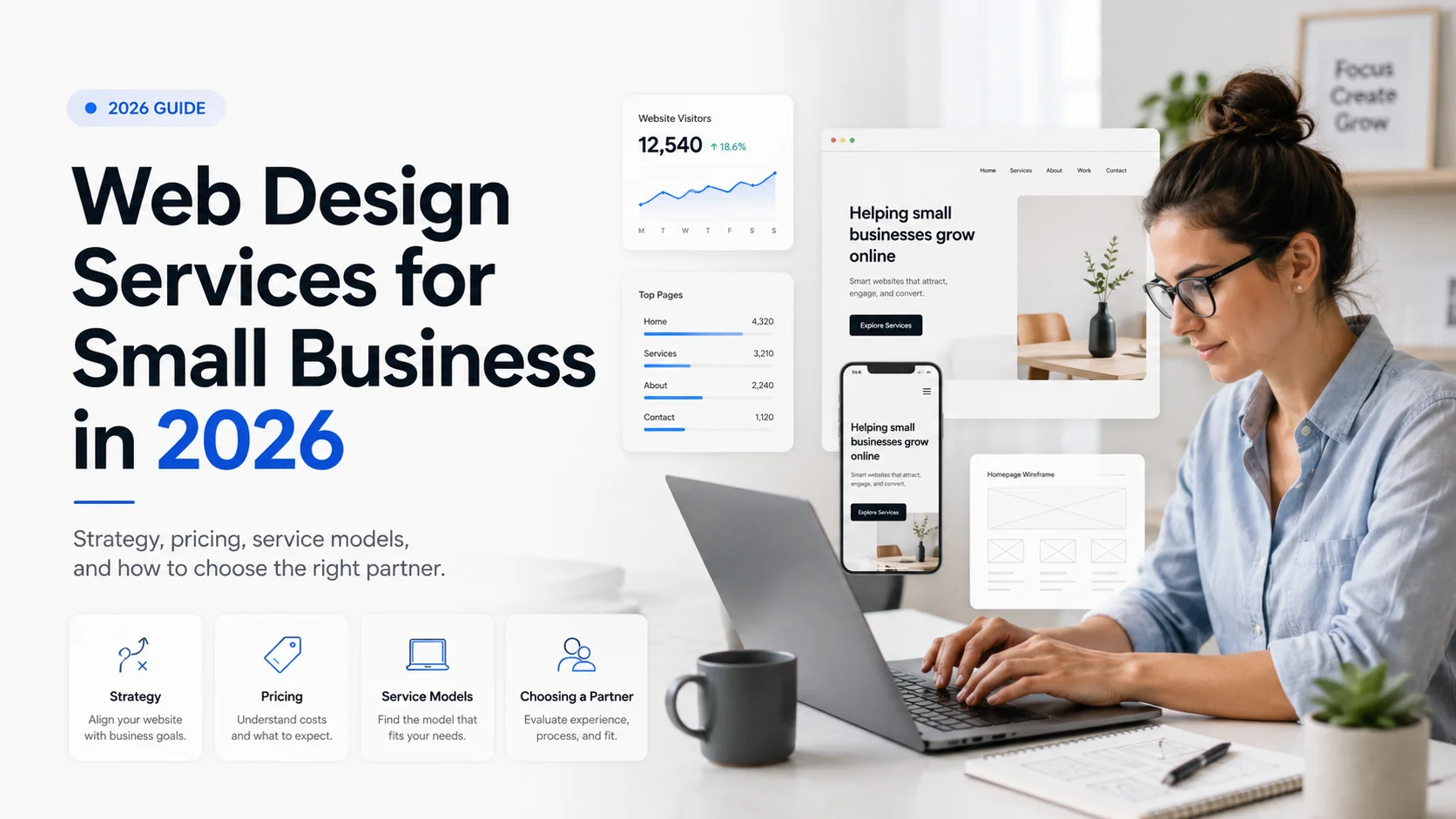
Is your website helping people trust your business, or is it quietly sending them somewhere else?
For many small business owners, it is confusing to choose web design services in 2026. One provider has a low cost template. Another recommends a custom site. Someone else says AI can build everything in minutes. The challenging part is figuring out exactly what your business needs.
Small Business Websites are no more just a digital brochure. It serves as your storefront, sales tool, credibility indicator, customer experience hub and marketing base. All of these elements of strategy, user experience, search engine optimization, content, speed, mobile performance, analytics, and continuous support are combined into a strong design.
This guide is designed to inform you about the services available, the cost of these services, the most suitable model for your business and how to select a Web Design Service provider with confidence.
Web Design Services are the processes undertaken by professionals to help a business plan, design, build and support a useful and trustworthy website.
For small businesses, these services usually include:
The best web design service is more than just pretty pages. It makes visitors feel like they know you, you offer, why to trust you and what they should do next.
For example: Service pages, photos of the project, reviews, a quote form and local SEO may be required for a local contractor. A family dentist can need to set appointments and obtain insurance details, develop treatment pages, respond to patient inquiries, and present trust-building photos. The design should be consistent with the actual decision-making process of customers.
Join for Web Design Consultancy
The online environment is now a more competitive space for small businesses. Before calling, booking, visiting or buying people compare websites. Weak website makes a good business look outdated, fuzzy or not trustworthy.
Use of mobile also makes design more paramount. In June 2026, Stat Counter found mobile account for 52.23% of the world's desktop versus mobile market share, meaning there's a fair chance your visitors will first visit your website on a mobile device.
Professional web design for small businesses helps with three big goals:
Stanford's Web Credibility Project has long pointed out the link between credibility and perceived trustworthiness and expertise. Website design is helpful for both when it features clear information, professional visuals, clear navigation, and proof like reviews or case studies.
Your small business website should be easy for visitors to navigate, easy to manage for your staff and capable of withstanding growth.
Your website should look great on every device: phone, tablet, laptop and desktop. Buttons should be easily tap. The text should be easy to read. Menu items must be easy to make.
Mobile-friendly design also has an impact on search visibility as Google advises for a positive experience on every device.
User experience and SEO will both be impacted by speed. Google's Core Web Vitals assess the true user experience of loading, interaction and visual stability. Google suggests an LCP of 2.5 seconds or less, an ITP of 200 milliseconds or less, and CLS of 0.1 or less. A slow site will lose traffic before it gets the visitors to read your offer.
Your services, pricing hints, contact information, reviews and take-action should be quickly discoverable. It's better to have a simple menu than a packed one.
The following pages may be helpful:
A website should not leave its visitors in any doubt. Use clear calls to action such as:
A good CTA is not pushy, but helpful instead.
SEO should be planned before the website is built. A web design service needs to consider page titles, page headings, URLs, internal links, image alt text, schema markup, page loading speed and the ability to be indexed.
Google's 2026 generative AI search guidelines state that while generative AI capabilities depend on Google's Search systems and indexed, crawlable pages, "foundational" SEO remains important.
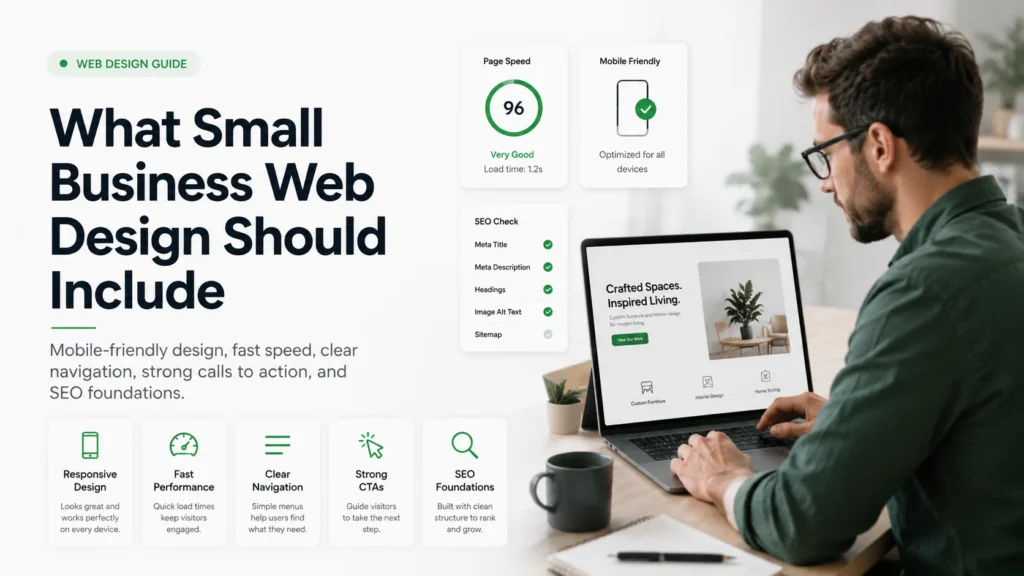
Makes your business easier to find, understand, and trust. It's important to make a good first impression because a well-designed website can help visitors quickly understand what you offer and how it benefits them.
There are several different business models. It will depend on your budget, time frame, objectives and the amount of support you need after the launch.
When it comes to choosing the right website service, it really depends on your needs and budget. If you're working with a very small budget and just need a simple site, a DIY website builder is worth considering — it's low-cost to start, but you'll be on your own when it comes to strategy and ongoing support. If you want something more custom without breaking the bank, hiring a freelancer can be a good middle ground; it's flexible and affordable, though support often ends once the site goes live. For businesses that just need to launch quickly, a template package offers a lower cost and faster timeline, but the trade-off is a less unique, more generic design.
If you're serious about growth, custom website design is built entirely around your specific goals — it just requires a bigger investment upfront. And if you want everything handled in one place — strategy, SEO, content, and development — a full-service agency gives you complete, end-to-end support, though it typically comes at a higher upfront cost. Finally, if your website already exists and you just need it kept running smoothly, a maintenance provider takes care of updates and security, but keep in mind — this isn't a substitute for an actual growth strategy.
If you have simple requirements, you can use any DIY site builder like Wix, Squarespace, Shopify, WordPress, Webflow, or Framer. TechRadar's 2026 website builder coverage includes platforms like Wix, Shopify, Squarespace, HubSpot, GoDaddy, and more, which have been evaluated based on features, usability, ecommerce, pricing, and support.
Freelancers may be a great option for an explicit, smaller project. The downside is the handoff cliff: The site has been completed but support is lost when there is a need for updates at a later stage. Agencies are typically more expensive but they also offer strategy, design, development, SEO, content, analytics and support.
The cost of a website depends on what is included. This is a five-page brochure site versus a custom ecommerce site featuring booking integration, CRM integration, SEO content, and tracking for conversions.
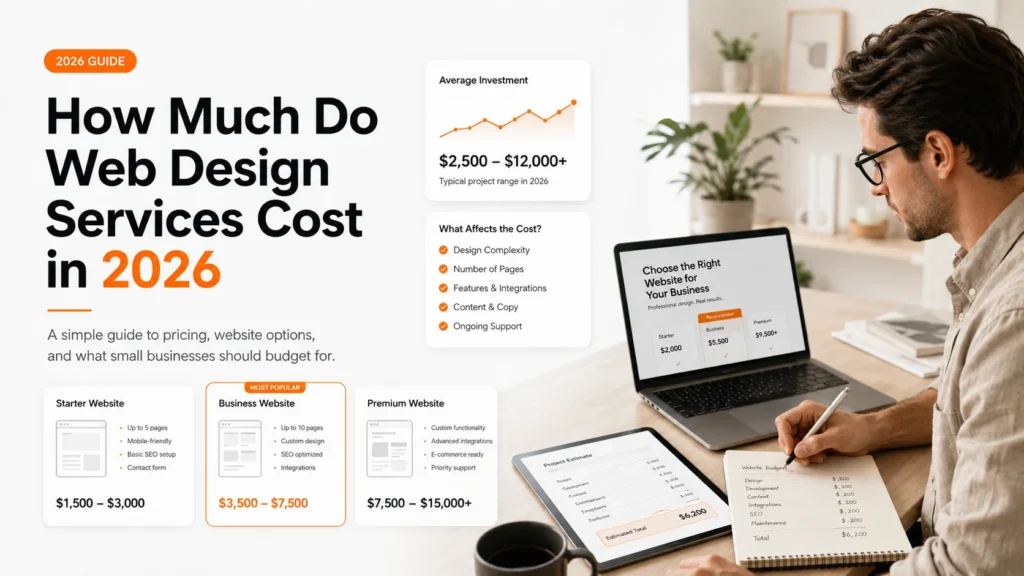
Current 2026 pricing guides show small business website projects cost between $500 and $25,000+ depending on the type of price quotes, which include basic template work to custom agency work.
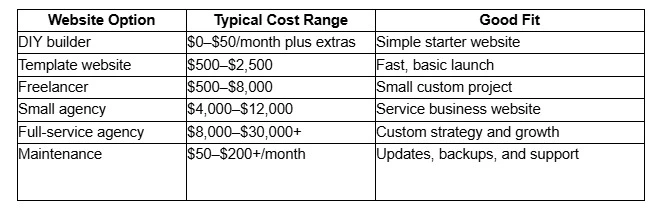
There may not be all of the costs visible in the initial quotation. Allow for domain renewal, hosting, premium plugins, copywriting, photography, SEO, analytics setup, security, backups, maintenance and future updates to pages.
For a short-term launch a less expensive website might suffice. A growth website requires better planning, content, development and conversion routes.
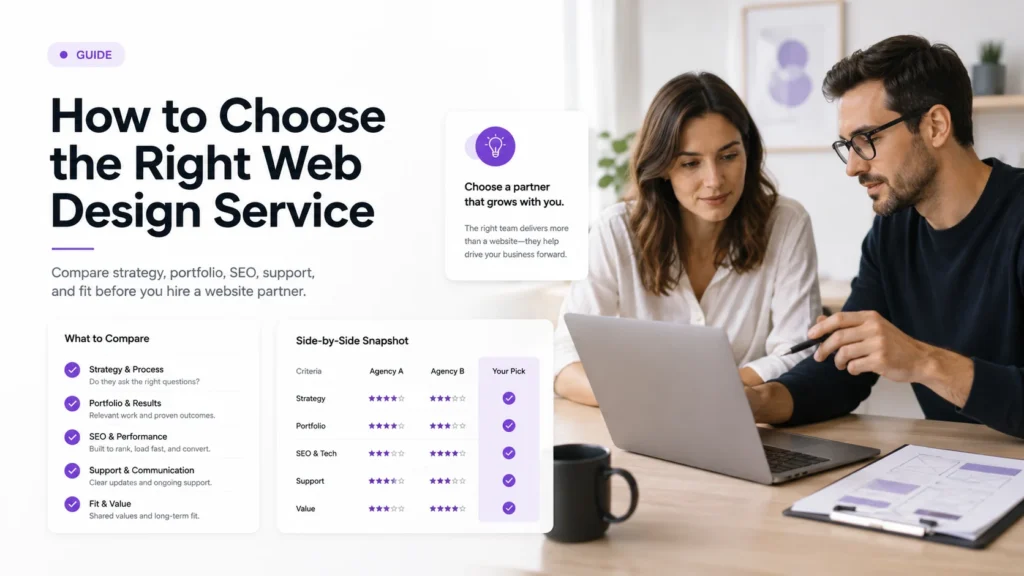
The first step towards selecting the right web design service is to understand the goal of your business.
Ask yourself:
Next, compare providers by more than design style. Respect a clear process, a relevant portfolio, a transparent pricing, the knowledge of SEO, a mobile-first attitude and post-launch support.
Before hiring any web design companies, ask:
The best website design firms and top web design companies typically give strategies before the visuals. They ask about your customers, goals, offers, competition, content, and long-term plans.
There are five phases to a robust website process.
This step involves setting your objectives, audience, competition, services, website pages, technical requirements and budget. This is often done without which results in fuzzy designs and untidy revisions.
Team develops sitemap, page plan and content direction. This keeps visitors going through the site in a sensible manner.
Designers make up the appearance and structure. The developers create the site using WordPress, Webflow, Shopify or other CMS.
The team performs mobile layouts, page speed, metadata, forms, links, redirects, tracking, and other basic technical SEO.
Launch is not the finish line. Real visitors need to be monitored, updated and improved on your website.
By identifying key events, such as form submissions, calls, purchases, or signups, Google Analytics allows businesses to measure and track specific significant actions that can be marked as conversions.
SEO and Design should go hand in hand. An eye-catching site can not only be ugly but also be confusing to search engines or difficult to navigate for users.
Good SEO-focused web design includes:
Local businesses should also have correct name, address, telephone number, hours, reviews and locations. Google's AI search guidance states that local business and ecommerce information can position businesses to show up in the right Google Search experiences, like generative AI results where applicable.
AI is revolutionizing the way users search, but robust websites are still crucial. Though search experiences change, customers still turn to clear and credible websites for making business, service and product choices.
Google is reiterating the importance of SEO in generative AI search. The business should concentrate on producing useful content, and have technical pages that can be crawled with a logical structure. Good images, local and ecommerce information, and organised information all contribute to visibility. Google also recommends not to take shortcuts, like generating content for AI rather than humans.
Small business websites should be easily verifiable and understandable. This involves developing well-structured service pages, incorporating FAQs, reviews and case studies and adding author or team details when applicable. Structured data and maintaining accurate contact details can also enhance trust and visibility, while using original photos can help.
AI website builders can help create draft websites, designs, and basic templates that can serve as a starting point. But they can't be a substitute for business strategy, customer research, brand positioning, conversion planning, or expert judgment. These tools are best used as support rather than a complete solution.
The role of AI in web design is likely to continue intertwined with human strategy in the future. By combining automation with careful planning and know-how, companies can build successful websites that align with evolving search habits.
As the need for having an online presence keeps increasing, so does the web design market. In 2025, it was estimated at USD 61.23 billion and expected to hit USD 92.06 billion by 2030. This is because of the growth of ecommerce, mobile site design, competition online, and a demand for robust user experience and interface design.
Preparation is time, money and confusion saving. Before speaking with a web design service, gather:
It's not necessary to have it perfect before you begin. A reputable agency will be able to help you in making details. If it is easy to communicate initial information, then it will go more smoothly.You can also join top web design services for beauty industry,

https://royaldigitalagency.com/blogs/web-design-services-beauty-salons/
Some top web design company lists emphasize awards, ratings and names of top clients. Those details can help, but small businesses need a more practical comparison.
Look for fit.
The provider you choose should know about your business, not solely your color tastes. They should describe what they suggest, and why. These should discuss users, search visibility, page speed, content, trust and conversions.
Compare these areas:
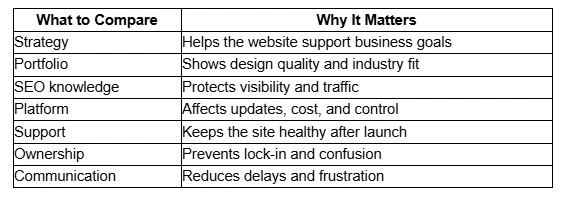
Design trends should enhance usability, not detract from it. Important 2026 website design trends include:
More people can use your site with clear color contrast, easy-to-read fonts, alt text, easy to navigate with the keyboard, and simple forms.
Interactive elements can be great with a purpose. A cost calculator or booking form, service quiz or product gallery can guide visitors to make their decision. Without careful planning, random animation can be detrimental to speed and usability.
Creating a website is more than just making it look nice. It should be able to serve your business objectives and escalate over time. There are five main reasons why we do growth-driven web design:
Your website should be about more than aesthetics; it should align with your business objectives. The design should lead customers towards the desired actions to increase the number of calls or bookings, if that is the objective.
Web design services help businesses plan, design, build, launch, and maintain a website. These can be a strategy, page layout, mobile design, development, SEO setup, copy support, forms, analytics, security and continuous updates.
Small business web design can be as low as $100/month for DIY platforms or thousands of dollars for professional design. The price range for basic packages is roughly $500 to $2,500, and for custom agency projects, it could be $8,000 to $30,000+ depending on the scope of the project.
If you have a straightforward website, a well-defined scope, and feel at ease orchestrating the project, you can hire a freelancer. Select a web design company when you have a need for strategy, SEO, development, content, integrations and support.
Here are the key features that should be included in a small business website: Homepage, Service Pages, About Page, Contact Page, Clear Call to Action, Reviews, Mobile-Friendly Design, Fast Loading Speed, SEO Basics, Security, and Analytics.
Website building companies often provide platforms or tools to create a site. Typically, web design firms offer strategy, design and development, setup and search engine optimization, and support services. Some companies require just a builder, while others require a complete service partner.
Some web design companies offer basic SEO services, others charge separately. Check whether the package covers keyword planning, metadata, heading structure, optimization of images, links to internal pages, page speed, redirects, Google Analytics set-up, schema markup, and more.
AI can help create a basic website draft, layout, or content outline. It is useful for speed, but it does not replace strategy, audience research, brand positioning, SEO planning, conversion design, or expert review.
Choose web design services by looking at your website goal, budget, timeline, and support needs. A top-notch provider should be familiar with strategy, mobile design, SEO, page speed, content, and conversions. Examine their portfolio, inquire about their website, look at what they say is included and verify who owns their website after their launch.
The cheapest web design services for small business are usually DIY website builders, template-based websites, or basic freelance design packages. They can be effective for a small budget website with a simple website design. Just be aware of additional expenses such as hosting, plugins, copywriting, images, SEO set up, etc. before finalizing the best price.
Begin by researching business website, Google Business Profile, mobile experience, speed and local search visibility. Then reach out with one or two specific improvements instead of a generic pitch. Demonstrate to them how improved web design can boost their sales volume of calls, quote requests, bookings or local customers. Be brief, informative and on-topic with their business goals.
Ecommerce web design services typically focus on leading platforms such as Shopify, WooCommerce, BigCommerce, or custom online store development. The right service should understand product pages, checkout flow, payment setup, shipping options, mobile shopping, inventory tools, SEO, and conversion tracking. Small businesses should look for a provider that has some actual e-commerce portfolio examples as well as post-launch support.
Finding a website partner can be frightening, particularly when all of the sites seem to have various sounds.
Royal Digital Agency offers web design solutions to small businesses in Los Angeles, California, including Glendale, specializing in creating clear, professional, SEO-optimized websites, and connecting to real business objectives. The strategy, user experience planning, mobile-first design and technical SEO setup are a structured process that is applied to each individual project to ensure long-term visibility.
Your focus isn't only on your website's appearance but its performance for your customers and growth. Whether you're a small service provider or a budding brand, Royal Digital Agency creates websites that are quick to load, pack with value and lead users to a meaningful action like a phone call, booking or enquiry.
Need a website that feels polished, loads fast, supports SEO, and helps visitors take the next step? Connect with Royal Digital Agency to plan a smarter website for your small business in Los Angeles, California or Glendale in 2026.



Let’s talk about how to take your product’s digital experience to the next level.


